
Imagine you are an employer reviewing a digital university diploma. It looks authentic and contains cryptographic proof of its origin. But before accepting it, you need to answer a more fundamental question:
Was the organisation that issued it actually authorised to issue that type of diploma?
The most direct approach would be to contact the university and request confirmation. That may work for one diploma. It becomes far more difficult when an organisation needs to verify thousands of diplomas, professional licences, attestations and other credentials issued across different countries.
This is the challenge an issuer trust model is designed to solve: how can a verifier establish trust in the organisation behind a credential without maintaining a direct technical relationship with every possible issuer?
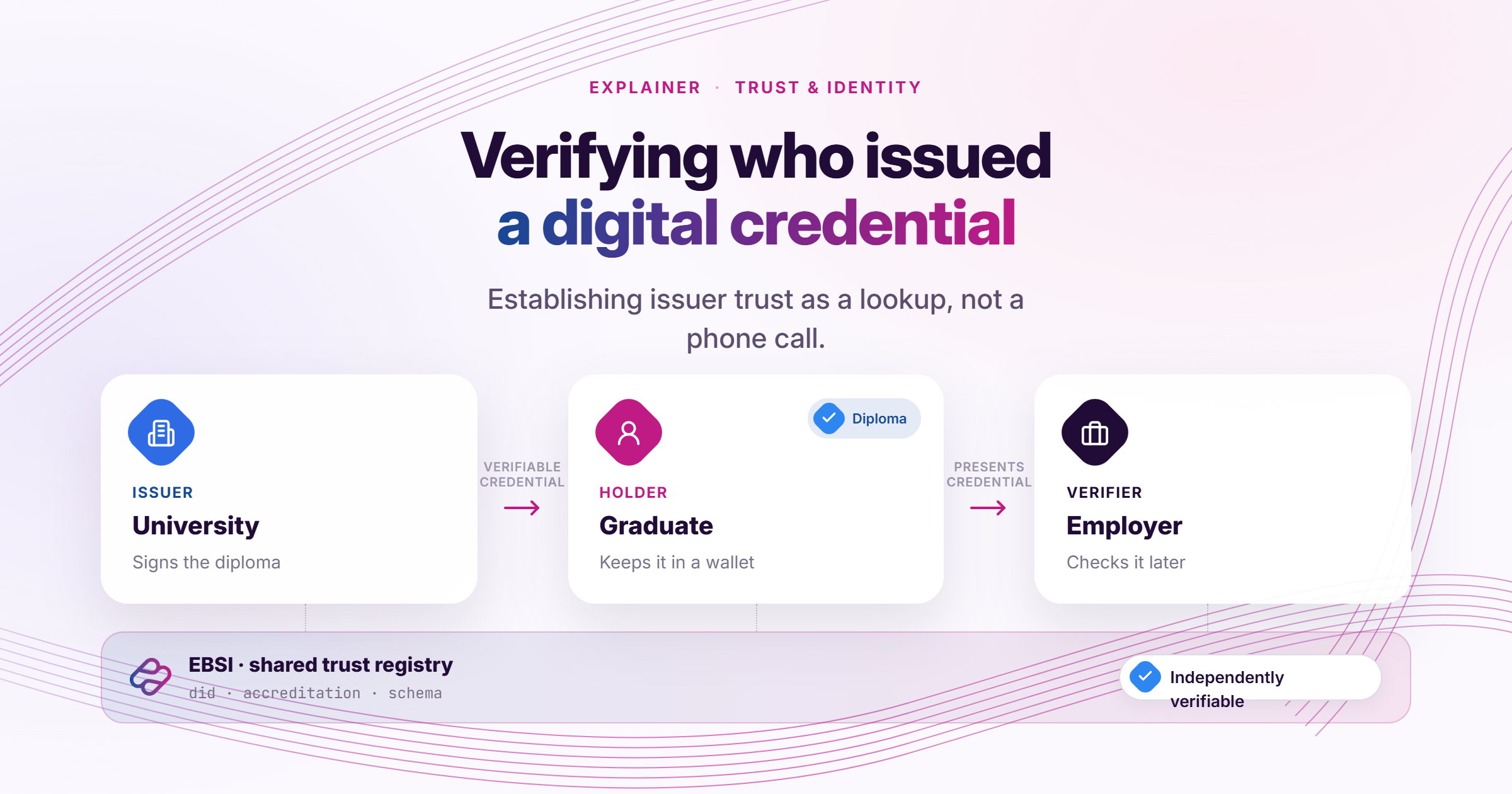
Three roles run through the model. An issuer creates and cryptographically secures a credential, such as a university awarding a diploma. A holder receives and keeps it, usually in a digital wallet. A verifier is whoever needs to evaluate it later, such as an employer.
The digital document exchanged between them is called a verifiable credential.
The cost of verifying directly with every issuer
In a traditional model, a verifier confirms information by contacting the organisation that issued the credential.
This approach works at a small scale but becomes difficult to maintain across large or cross-border ecosystems.
The cost falls in three places.
First, each issuer must operate a service that verifiers can contact. A university may need to maintain secure and continuously available infrastructure so that third parties can check diplomas awarded years earlier.
Second, each verifier must build and maintain connections to every issuer it may encounter. In an open, cross-border ecosystem, this could mean hundreds or thousands of separate integrations.
The third cost is privacy. When an issuer is contacted every time a credential is checked, it may learn where and when the holder is using it. This can create a trail linking one person’s activity across otherwise unrelated services.
One design problem sits beneath all three: direct verification focuses on how to reach the issuer, when the more important question is whether the issuer was authorised to issue the credential at all.
Quote here
Turning issuer trust into a lookup
Modern trust infrastructures approach this differently. Issuer trust information can be made available through shared registries, allowing a verifier to retrieve the public information it needs without contacting the issuer directly.
There are several ways to organise this information.
A centralised model may rely on certificates managed by a central authority. A federated model may use trusted lists agreed between participating parties. A distributed model makes trust information available through shared infrastructure that verifiers can consult independently.
EBSI is one implementation of the distributed approach.
Within EBSI, issuers are represented through decentralised identifiers, or DIDs. These identifiers link organisations to the public-key information needed to verify the cryptographic proofs applied to their credentials. Accreditations and credential schemas provide further evidence about what an organisation is permitted to issue.
The infrastructure does not, however, decide which organisations should be trusted.
That remains a governance decision made by the relevant public authority, regulator or recognised accreditation body. EBSI makes the evidence of that decision visible, reusable and independently verifiable.
The ledger does not create trust. It makes an established chain of authority easier to verify and reuse.
The organisations behind the trust chain
The issuer trust model distinguishes between the organisations that grant authority and those that issue credentials.
Within EBSI, a trust chain includes three roles.
A Root Trusted Accreditation Organisation, or Root TAO, anchors and governs the trust chain. It represents an authority that verifiers may choose to recognise within a particular jurisdiction, sector or policy framework.
A Trusted Accreditation Organisation, or TAO, receives authority to accredit organisations further along the chain. It may be responsible for a particular sector, jurisdiction or category of credential.
A Trusted Issuer, or TI, is an organisation that has received accreditation to issue specific types of credentials.
The same organisation may perform more than one role, depending on how the ecosystem is governed.
In education, for example, a ministry could act as the Root TAO. It could delegate the accreditation of higher-education institutions to a specialised national body acting as a TAO. Accredited universities would then act as Trusted Issuers permitted to issue particular types of diplomas.
This allows the digital trust chain to reflect the governance structures that already exist within each country or sector.
The result is not simply a list of organisations labelled “trusted.” It is a traceable chain showing:
- who authorised the organisation;
- what it is authorised to issue;
- within which jurisdiction;
- and under which policies or credential schemas.
How issuer trust is established
Consider the example of a university diploma.
1. The rules are defined
The relevant authorities agree on the structure and requirements of the diploma.
A credential schema describes the data model that participating issuers should follow. It helps verifiers understand what information the diploma should contain and how that information is structured.
2. The university establishes its digital identity
The university creates a decentralised identifier and registers the corresponding DID document.
The DID document contains the public-key information that allows others to verify cryptographic proofs created by the university.
A legal entity may use an electronic seal to establish the origin and integrity of information. Although electronic seals and electronic signatures perform related technical functions, they remain distinct concepts under EU law.
3. The university is accredited
The responsible accreditation organisation assesses the university and issues a verifiable accreditation confirming that it is authorised to issue diplomas.
The accreditation can specify the types of credentials the university may issue, the applicable jurisdiction and the relevant policies or schemas.
4. The trust information is registered
The university’s identifier, public-key information, accreditation and relevant credential schema are made available through EBSI’s registries.
The university can then issue a digital diploma to a graduate, who keeps it in a digital wallet.
The diploma itself and the graduate’s personal information are not published on the ledger. The shared infrastructure contains the public information required to evaluate the organisation behind the credential.
5. The diploma is presented and checked
When the graduate presents the diploma to an employer, the employer can independently check:
- which organisation issued it;
- whether its cryptographic proof can be verified using the issuer’s public key;
- whether the organisation was authorised to issue that type of diploma;
- whether the accreditation chain leads back to a root authority recognised under the verifier’s trust policy;
- and whether the credential follows the expected schema.
Credential status is a separate part of the wider verification process. Depending on the credential and the verifier’s policy, additional checks may be needed to determine whether it has expired, been suspended or been revoked.
The issuer trust model addresses the specific question of who stands behind the credential and what that organisation was authorised to issue.
No direct request to the university is required to establish that issuer trust, and consulting the registry does not inherently notify the university that the credential is being used.
Trust chains that reflect real institutions
A trust chain distinguishes between organisations that grant authority and organisations that issue credentials.
A national authority may delegate responsibility to a sector-specific organisation, which may then accredit individual issuers. Each link in the chain defines what an organisation is authorised to do and under which conditions.
For example:
- a Member State recognises a root accreditation organisation for education;
- the root organisation accredits a specialist body responsible for higher-education institutions;
- that body accredits individual universities;
- and those universities issue digital diplomas to students.
Starting from a credential, a verifier can follow the accreditation chain back to a root authority it recognises.
Different domains can establish their own trust chains on the same infrastructure. Education, social security and other sectors can define their own authorities, policies and credential schemas without requiring separate verification infrastructure for every use case.
Registration does not mean that every verifier must automatically accept every issuer. A verifier still determines which trust roots, jurisdictions, policies and credential types it recognises.
The shared infrastructure provides the evidence needed to apply those decisions consistently.
What this changes
Once a trust chain is established, verifying the organisation behind a credential becomes a lookup rather than a bilateral enquiry.
Issuers do not need a separate technical relationship with every organisation that may later receive their credentials. Verifiers do not need to know or integrate with every possible issuer in advance.
The model also allows issuers to manage and rotate their cryptographic keys without repeating the entire accreditation process, supporting more secure key management over time.
For public administrations and businesses, this creates a foundation for credentials whose origin, authority and integrity can be evaluated across organisational and national boundaries.
A university in one Member State can issue a diploma that an employer or public authority in another can evaluate without either party building a dedicated connection to the other.
The institutions retain their existing governance responsibilities. The shared infrastructure provides the technical means to make evidence of those responsibilities independently verifiable.
As more public and private services exchange digital credentials across borders, independently verifiable issuer trust becomes a foundational capability. Shared trust infrastructure enables institutions to reuse existing governance while making that trust scalable, interoperable and privacy-preserving.