Developer Hub
Open source. Run it locally, test conformance, connect when ready.
Explore Developer Hub


Helping the EU Fishing Industry to enhance product traceability, food safety, and combat illegal fishing.


Together, the TRACE4EU Consortium is working with the Directorate of Fisheries, Fishers, Norges Råfisklag, Food Safety Authorities, Equipment Compliance Authorities, Customs, and Taxation Authorities to address the issues of insufficient data, lack of standardization, tracing the origin of king crabs, and detecting illegal fishing. This collaboration ensures that the authority and end customer can have complete confidence in having high-quality, sustainably sourced crabs
Lorem ipsum dolor sit amet, consectetur adipiscing elit, sed do eiusmod tempor incididunt ut labore et dolore magna aliqua. Ut enim ad minim veniam, quis nostrud exercitation ullamco laboris nisi ut aliquip ex ea commodo consequat. Duis aute irure dolor in reprehenderit in voluptate velit esse cillum dolore eu fugiat nulla pariatur.
Block quote
Ordered list
Unordered list
Bold text
Emphasis
Superscript
Subscript


It has been reported that approximately 20% of fish caught globally fall under the Illegal, Unreported, and Unregulated (IUU) category, with total costs ranging from $10 billion to $23 billion every year. Illegal fishing has also been highlighted by the Norwegian Police Security Service (PST) in their 2022 annual report as a major societal problem undermining sustainable resource management.
Norway has launched the Automatic Identification System (AIS) to maintain a continuous overview of fishery vehicle traffic along the Norwegian coast and at sea. Although it can track vessels at large, it is still difficult to track individual products and ensure complete traceability for the authority and end customer.


The Europen Blockchain Services Infrastructure (EBSI) allows the Seafood Tracing project to design, build, and operate the next generation of seafood supply-chain services for the benefit of EU economies. The Seafood Tracing project aligns with the EU's digital policy and circular economy goals, aiming to develop traceability system capabilities by 2028 using the Digital Product Passport (DPP). Within this context, EBSI is used as the trust model to issue and verify verifiable credentials, issue QR codes to each individual product, and register on the ledger supply chain events.
EBSI allows this project to operate the next generation of decentralized tracing services with the objective of building an infrastructure designed to:
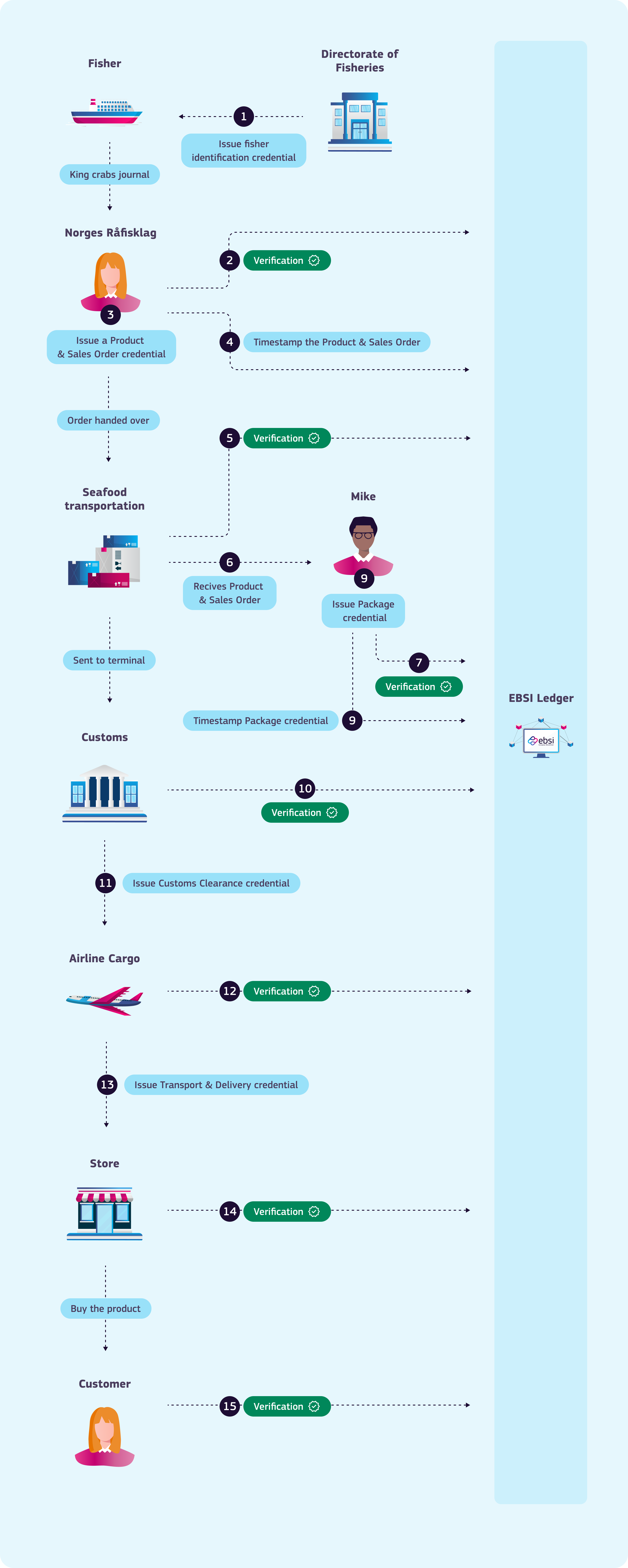
Bob works for a seafood transportation company in Norway
Mike works for Norges Råfisklag and is in charge of packing crabs at the airport terminal
John is a Norwegian Customs officer in charge of seafood exports.
Mark is an Airline Cargo operator in Norway.
text
p
EBSI is open source under the European Public Licence. Evaluate the full stack locally, and connect to the live network when ready.
Lorem ipsum dolor sit amet, consectetur adipiscing elit, sed do eiusmod tempor incididunt ut labore et dolore magna aliqua. Ut enim ad minim veniam, quis nostrud exercitation ullamco laboris nisi ut aliquip ex ea commodo consequat. Duis aute irure dolor in reprehenderit in voluptate velit esse cillum dolore eu fugiat nulla pariatur.
Block quote
Ordered list
Unordered list
Bold text
Emphasis
Superscript
Subscript