Developer Hub
Open source. Run it locally, test conformance, connect when ready.
Explore Developer Hub


Framing data management practices in the creative industries to improve authoritative and updated information on rightsholders, terms and conditions, and licensing opportunities.


Bringing together a data infrastructure and governance framework to facilitate rights data pooling and sharing. A Common European data space for copyright ensures that more data rights become available for use in the creative industries, while keeping the companies and individuals who generate the data in control.
Lorem ipsum dolor sit amet, consectetur adipiscing elit, sed do eiusmod tempor incididunt ut labore et dolore magna aliqua. Ut enim ad minim veniam, quis nostrud exercitation ullamco laboris nisi ut aliquip ex ea commodo consequat. Duis aute irure dolor in reprehenderit in voluptate velit esse cillum dolore eu fugiat nulla pariatur.
Block quote
Ordered list
Unordered list
Bold text
Emphasis
Superscript
Subscript


The creative sectors are facing data-related challenges in four areas: costs of rights management, effectiveness and efficiency of rights licensing, payment processes for rights remuneration, misappropriation, and other rights infringements.


The European Blockchain Services Infrastructure (EBSI) allows the pilot project to store and intermediate trusted rights data. Rightsholders will register rights and receive registration tokens. Rights users will query rights management information and receive trusted rights data.
The data needs to answer the following fundamental questions:
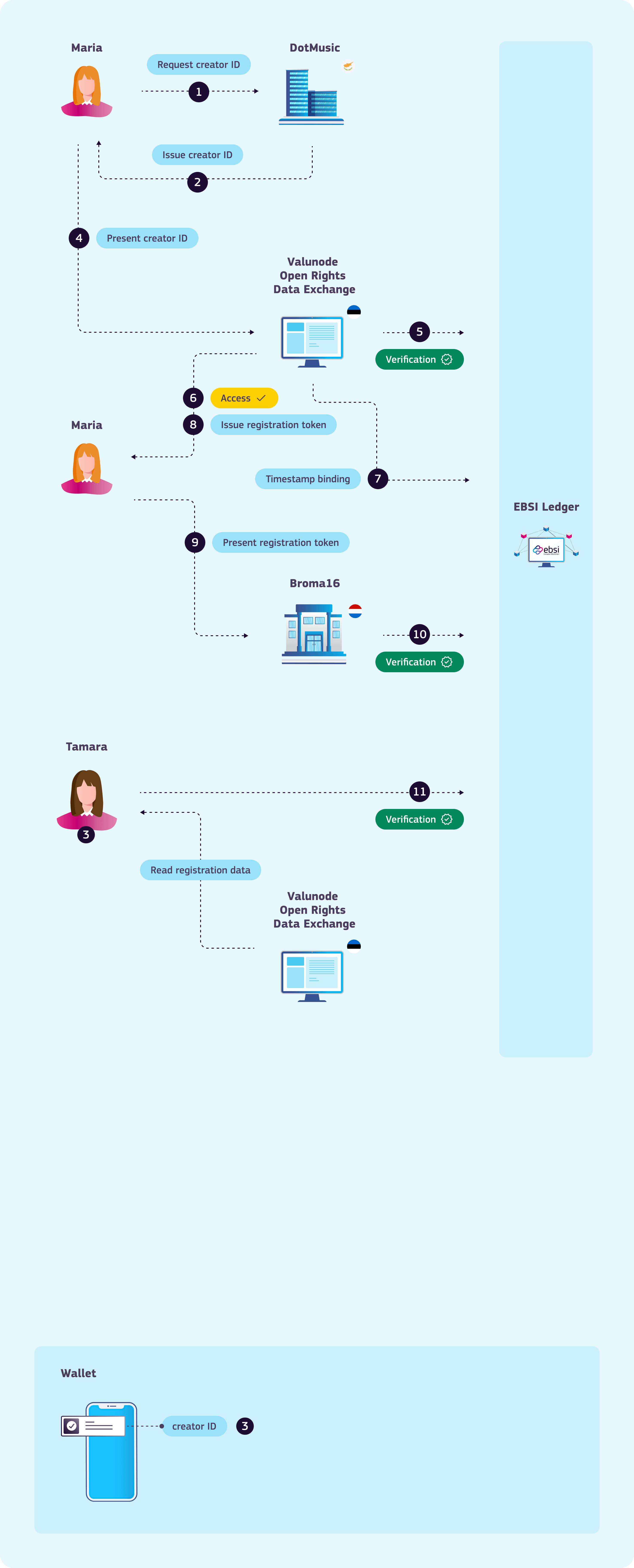
Maria is a folk songwriter/performer in Portugal.
As Maria is also the producer of her own recording, she holds the publishing rights to her song and the master rights to the recording. To register a recording, Maria uploads the recording on the ORDE which fingerprints it and immutably binds this content fingerprint with her creator ID.
She then enters information on the ORDE about her work including industry codes, the members of her band, their roles and creator IDs, and the percentage of royalties which will be owed to them. Maria adds machine-readable terms and conditions for the use of her work, which can include the expression of her opt-out from text and data mining. This information is stored off-chain, either on a peer-to-peer network for public metadata or on a permissioned database for private metadata.
Miguel is a documentary film director (SP) who wants to insert Portuguese folk music into his film. Miguel searches the Web and finds Maria’s intriguing recording.
text
p
EBSI is open source under the European Public Licence. Evaluate the full stack locally, and connect to the live network when ready.
Lorem ipsum dolor sit amet, consectetur adipiscing elit, sed do eiusmod tempor incididunt ut labore et dolore magna aliqua. Ut enim ad minim veniam, quis nostrud exercitation ullamco laboris nisi ut aliquip ex ea commodo consequat. Duis aute irure dolor in reprehenderit in voluptate velit esse cillum dolore eu fugiat nulla pariatur.
Block quote
Ordered list
Unordered list
Bold text
Emphasis
Superscript
Subscript